Appliances
How to clean an air fryer: everyday and deep clean
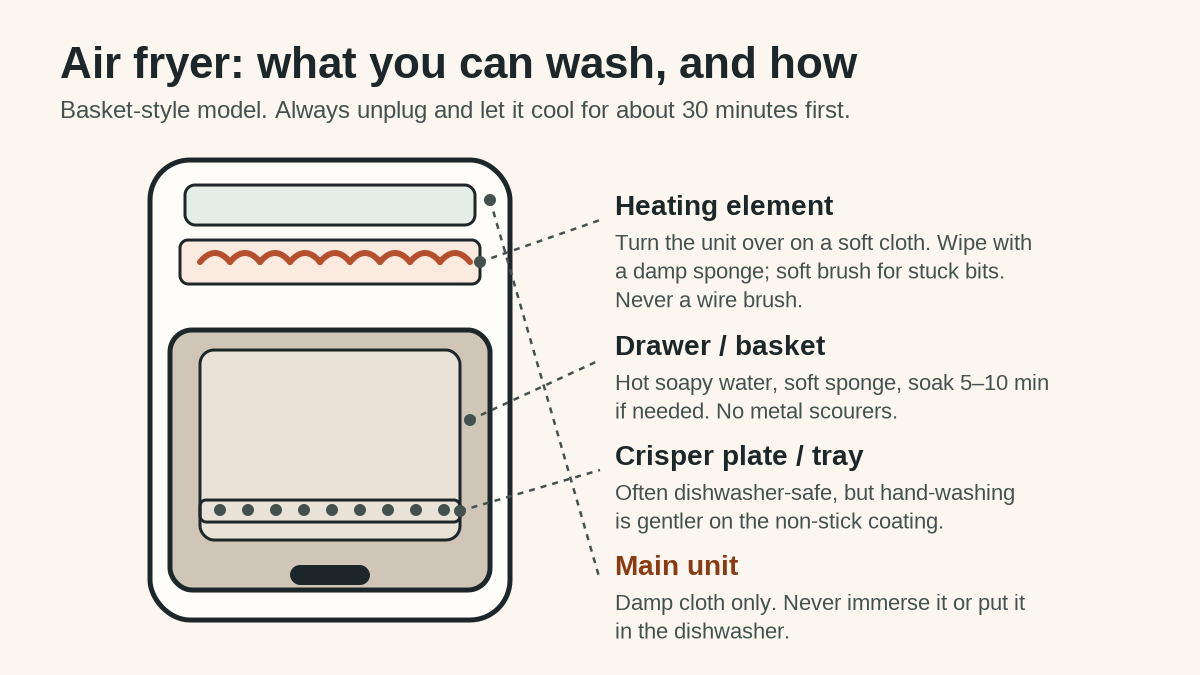
How to clean an air fryer basket, drawer and heating element without damaging the non-stick coating, with a quick after-use routine and a monthly deep clean.
Appliances
How to convert oven recipes to an air fryer in °C, including fan ovens and gas marks: the simple rule, a conversion chart, worked examples and a free calculator.
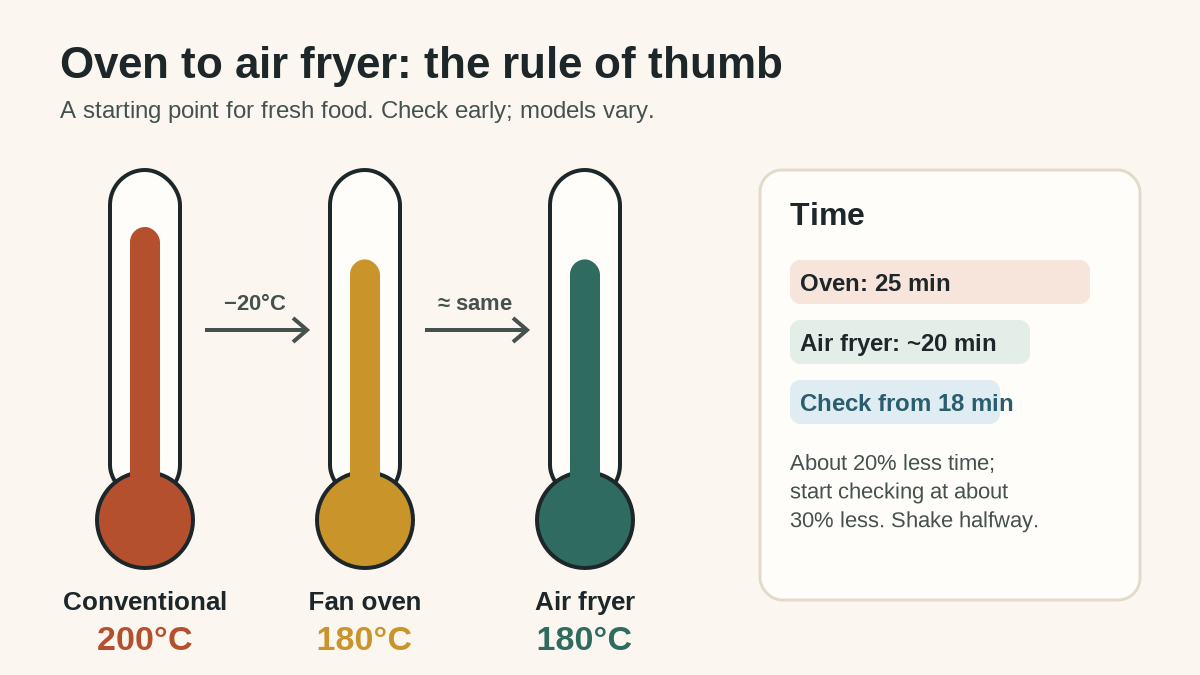
Most British recipes, and almost every packet in the supermarket, are written for an oven. An air fryer is really a small, powerful fan oven: a heating element above the food and a fan that blows hot air around a small space. Because the space is smaller and the air moves faster, food usually cooks quicker and browns more readily, so oven instructions need adjusting.
The good news is that a simple rule gets you most of the way there. Use it as a starting point, then adjust for your model.
For fresh food from a recipe written for a conventional (non-fan) oven:
This is the same rule the Mid and East Antrim air fryer cookbook, produced by a Northern Irish council, uses, and it matches what most manufacturers recommend. Instant Brands’ UK guidance suggests cutting cooking time by 20–25%.
Fan oven recipes: a fan oven already moves air around, so the temperature is close to what an air fryer needs. Use the same temperature as the fan setting, and still cut the time by about 20%.
Frozen, ready-to-cook food like oven chips, nuggets and fish fingers is designed to cook from frozen. If the packet gives air fryer instructions, and most now do, use them. If not, keep the oven temperature (most air fryers top out around 200°C) and start checking at about half the oven time.
Let us do the maths. Our free oven-to-air-fryer calculator converts conventional, fan and gas mark temperatures, and gives you a cooking time and a “start checking at” time.
Gas marks are converted to approximate conventional oven temperatures, as printed on most UK recipes.
| Gas mark | Conventional oven | Fan oven | Air fryer (fresh food) |
|---|---|---|---|
| 1 | 140°C | 120°C | 120°C |
| 2 | 150°C | 130°C | 130°C |
| 3 | 170°C | 150°C | 150°C |
| 4 | 180°C | 160°C | 160°C |
| 5 | 190°C | 170°C | 170°C |
| 6 | 200°C | 180°C | 180°C |
| 7 | 220°C | 200°C | 200°C |
| 8 | 230°C | 210°C | 200°C (most models’ maximum) |
| 9 | 240°C | 220°C | 200°C (most models’ maximum) |
If your air fryer goes higher than 200°C, you can use the higher figure, but keep a close eye on the food.
| Oven time | Air fryer time (fresh) | Start checking (fresh) | Start checking (frozen) |
|---|---|---|---|
| 10 min | 8 min | 7 min | 4 min |
| 15 min | 12 min | 11 min | 6 min |
| 20 min | 16 min | 14 min | 8 min |
| 25 min | 20 min | 18 min | 10 min |
| 30 min | 24 min | 21 min | 12 min |
| 40 min | 32 min | 28 min | 16 min |
| 45 min | 36 min | 32 min | 18 min |
| 60 min | 48 min | 42 min | 24 min |
These are our rule-of-thumb starting points, worked out from typical oven instructions. They’re not times we’ve tested in a lab. Air fryers vary a lot, so check early.
| Food | Typical oven instructions | Air fryer starting point |
|---|---|---|
| Sausages (fresh) | 200°C, 25 min | 180°C, about 20 min. Turn halfway. |
| Chicken thighs, bone-in | 200°C, 40 min | 180°C, about 32 min. Check from 28 min. |
| Salmon fillets | 200°C, 15 min | 180°C, about 12 min |
| Roasted vegetables | 200°C, 30 min | 180°C, about 24 min. Shake twice. |
| Roast potatoes (parboiled) | 200°C, 45 min | 180°C, about 36 min. Shake every 10 min. |
| Jacket potato | 200°C, 60 min | 180°C, about 48 min. Check with a knife. |
| Frozen oven chips | 200°C, 20 min | Packet air fryer instructions, or 200°C and check from 10 min |
Don’t overfill the basket. Hot air needs to reach every surface. A single layer with gaps cooks evenly. A heaped basket steams. Cook in batches if you need to.
Shake or turn halfway. Chips, veg and nuggets need a shake. Larger items like chicken thighs and fillets need turning.
Use a little oil on fresh food. Toss potatoes or veg in a teaspoon or two of oil. It browns much better than dry food.
Cut evenly. Similar-sized pieces cook at the same rate.
Account for preheating. If your model has no preheat, add a minute or two.
Know your model. Small baskets with powerful elements cook faster than large ones. Dual-basket models can run each side at a different setting. After a few meals you’ll know whether yours runs hot.
Not every oven recipe moves across neatly.
Wet batters. A runny batter, like the one for fish, drips through the basket before it sets. Use a breadcrumb coating instead, or chill battered food before cooking so it firms up.
Cakes and bakes. Small cakes, muffins and brownies work in a tin or silicone mould that fits the basket. Take an extra 10°C off and check with a skewer early, because the top browns before the middle sets. Covering loosely with foil can help, but only if your manual allows foil and it’s held down so the fan can’t lift it.
Big joints. A whole chicken or a large joint may fit, but it’ll sit close to the element. Lower the temperature and turn it partway through. A thermometer is very useful here.
Saucy dishes. Casseroles and pasta bakes need an ovenproof dish that fits the drawer with room for air to circulate. They gain less from an air fryer than crispy foods do.
Light foods. Very light items like kale crisps or loose cheese can be blown around by the fan. Weigh them down or use a rack lid if your model came with one.
Air fryers brown the outside quickly, which can make food look done before the middle is cooked. The Food Standards Agency’s guidance on cooking your food is to make sure poultry, pork, burgers, sausages and rolled joints are steaming hot all the way through, with no pink meat and juices that run clear. Reheated food should be steaming hot too.
Check the thickest part. Cut into the thickest part of meat, or use a food thermometer. Food Standards Scotland says a thermometer in the thickest part should read 75°C or above. Never use the air fryer’s display as proof that food is cooked.
For everyday portions, usually yes. Which? compared air fryers with ovens and found air fryers generally cheaper to run for small meals, because they don’t have to heat a large cavity and they cook faster. The saving gets smaller, or disappears, when you’d need several air fryer batches to cook what fits in one oven load.
Grease left in the drawer makes the next meal smoky and wears the coating. A quick wash after every use helps a lot. See our guide to cleaning an air fryer.
A 180°C fan oven is roughly 200°C in a conventional oven. Using the rule of thumb, that becomes about 180°C in an air fryer. Cut the time by about 20%, and start checking a little earlier.
For fresh food, about 16 minutes, checking from 14 minutes. For frozen chips or nuggets, start checking from about 10 minutes, or use the packet’s air fryer instructions if there are any.
Some models have a preheat function and some recipes assume one, but many air fryers heat up in two or three minutes. If you don’t preheat, add a minute or two to the cooking time. Check your manual.
Usually, yes, for small portions. Which? tests found air fryers generally use less energy than a full-size oven because they heat a smaller space for a shorter time. For large batches, a full oven can be just as efficient.
The temperature is probably too high for the size of food. Lower it by 10–20°C and cook a little longer, and cut large items into smaller, even pieces.
This guide is general advice for UK homes. Your appliance manual and product labels come first: if they say something different, follow them. Spotted something wrong or out of date? Tell us and we’ll check and correct it.
How to clean an air fryer basket, drawer and heating element without damaging the non-stick coating, with a quick after-use routine and a monthly deep clean.
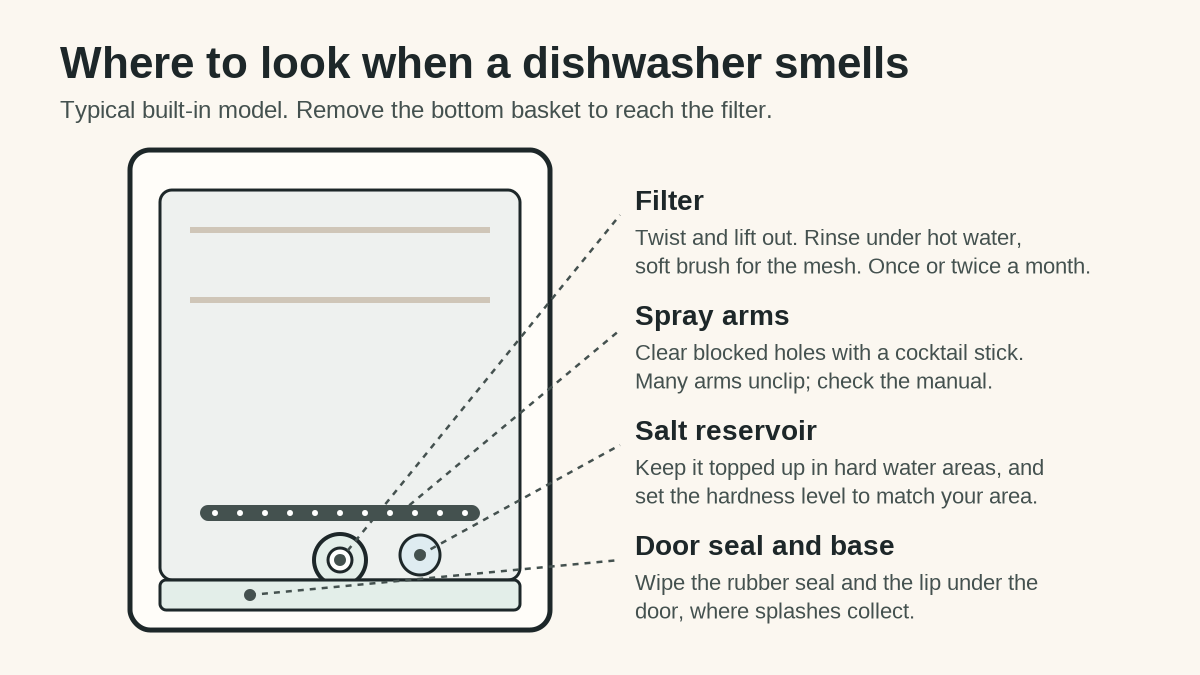
How to clean a dishwasher step by step: the filter, spray arms, door seal and a hot cleaning cycle, plus salt and rinse aid settings for UK hard water and how to fix smells and cloudy glasses.
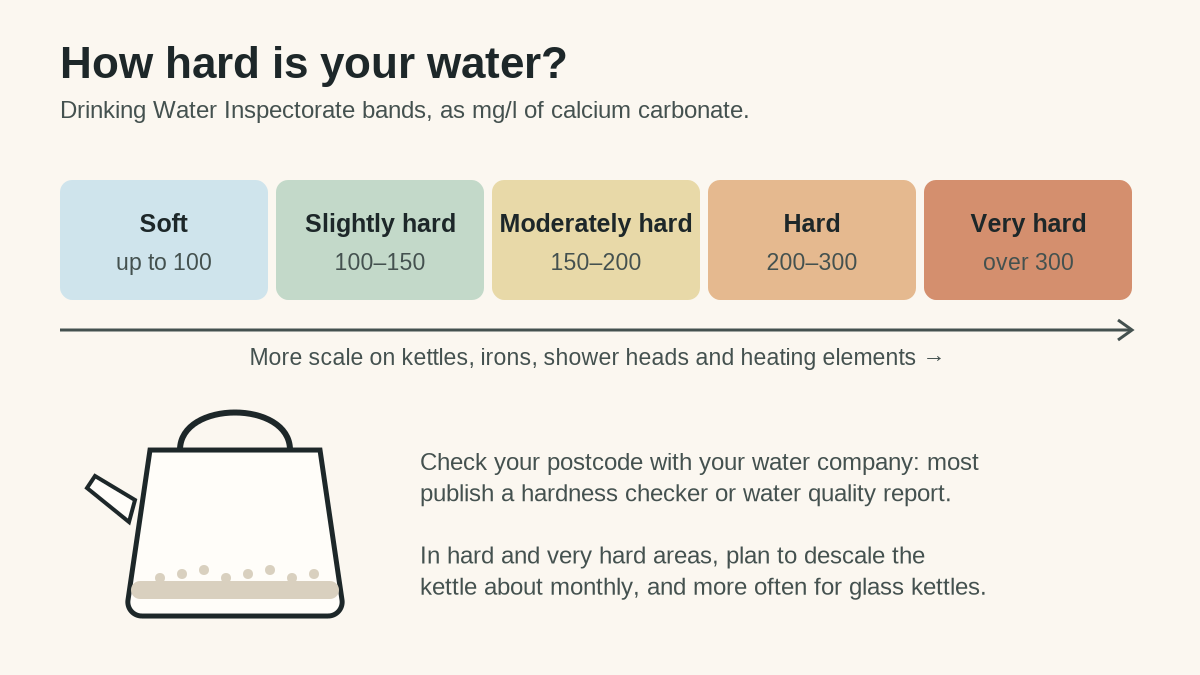
How to remove limescale from a kettle with citric acid, white vinegar, lemon or a shop descaler, how often to do it in UK hard water areas, and how to clean the limescale filter.