If you live in London, the South East, East Anglia or much of the Midlands, you’ll know the signs: a crust on the kettle element, flakes in your tea, and a film on the top of the cup. That’s limescale, and it builds up fast in hard water areas. Descaling takes about half an hour and costs pennies, and a clean kettle boils faster.
What limescale is, and why it matters
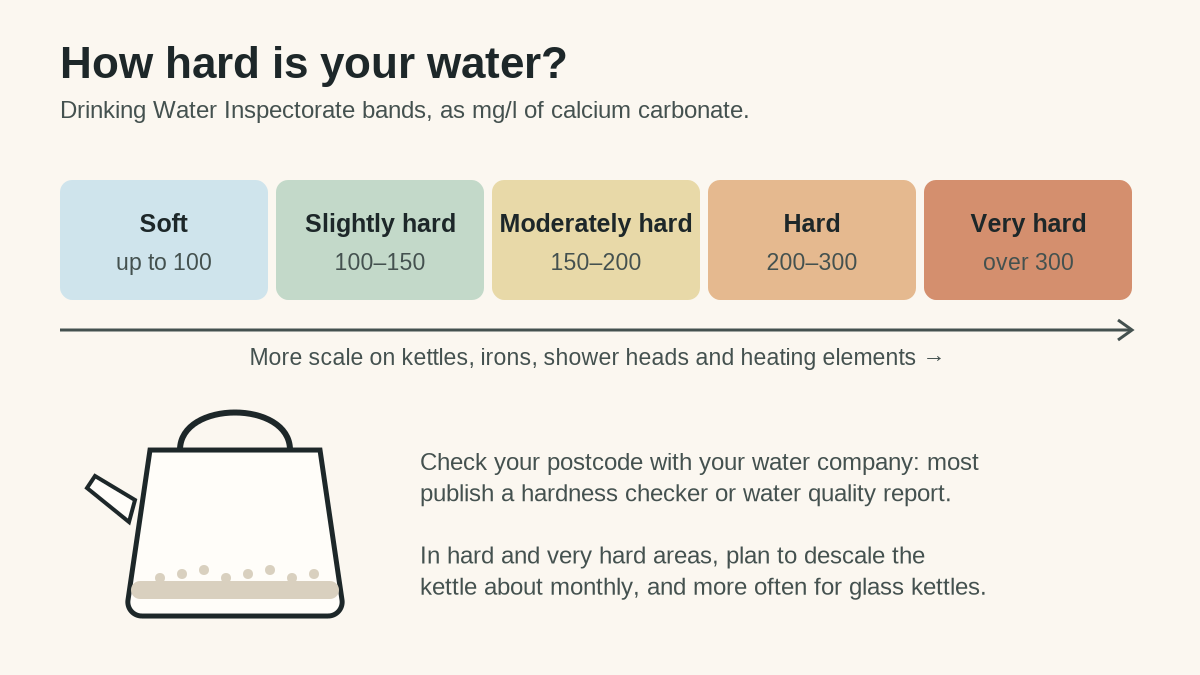
Hard water contains dissolved calcium and magnesium. When you heat it, some of those minerals come out of the water as calcium carbonate: limescale. The Drinking Water Inspectorate classifies water by the amount of calcium carbonate it carries:
| Band |
Calcium carbonate (mg/l) |
| Soft |
Up to 100 |
| Slightly hard |
100–150 |
| Moderately hard |
150–200 |
| Hard |
200–300 |
| Very hard |
Over 300 |
Limescale isn’t harmful. Which? is clear that it’s safe to drink, and claims that it causes kidney stones are untrue. But it does make the element less efficient, so the kettle takes longer and uses more energy to boil. It can also make tea taste flat or slightly bitter.
How often to descale
Which? suggests descaling about once a month. If you have a glass kettle and live in a hard water area, you may need to do it more often, because the scale is visible and builds up quickly. In a soft water area, every few months may be enough. The simplest test is to look: if you can see a white or brown crust on the base or element, it’s time.
Safety. Always switch off and unplug the kettle before adding anything, and don’t let it boil dry. Citric acid fizzes when it hits hot water, so add it slowly with the lid open, and keep your face away. Don’t overfill: a vinegar solution can froth up. Never use bleach in a kettle, and never mix descaler with other cleaning products. Always boil and discard fresh water afterwards before you drink from it.
Method 1: Citric acid (our first choice)
Citric acid is cheap, works quickly in hot water and doesn’t leave a smell. You’ll find it in the baking or cleaning aisle of larger supermarkets, in hardware shops and online. It’s also the active ingredient in many branded kettle descalers.
- Fill the kettle about halfway with water and boil it.
- Switch off and unplug the kettle.
- Add one to two tablespoons of citric acid, a spoonful at a time. It’ll fizz as it reacts with the scale.
- Leave it for 15 to 20 minutes.
- Pour it away and rinse the kettle several times.
- Wipe away any loose bits with a soft bottle brush or the soft side of a sponge.
- Fill with fresh water, boil, and pour away. Do this two or three times.
This method follows Which?’s citric acid instructions. For a very scaly kettle, do it twice rather than using a lot more acid.
Method 2: White vinegar
- Mix equal parts white vinegar and water.
- Fill the kettle about three-quarters full with the mixture.
- Bring it to the boil, then leave it to stand until completely cool.
- Pour it away and rinse several times, using a long-handled brush on any stubborn patches.
- Boil fresh water and pour it away two or three times to get rid of the vinegar taste.
Vinegar is a little slower than citric acid and the smell lingers, so open a window.
Method 3: Lemon juice
For light scale, squeeze two lemons into a half-full kettle and drop the squeezed halves in too. Boil, leave for about an hour, then rinse and do the fresh-water boils. It smells better than vinegar, but it’s weaker.
Method 4: Shop-bought descaler
Kettle descaler sachets and liquids are sold in supermarkets and hardware shops. Follow the instructions on the pack exactly. Dosage and contact times vary between products. Some contain stronger acids, so wear gloves and keep them away from the outside of the kettle, which may be marked.
Comparison
| Method |
Cost per descale |
Time |
Smell |
Best for |
| Citric acid |
Pennies |
20–30 min |
None |
Regular descaling, heavy scale |
| White vinegar |
Pennies |
2–3 hours (cooling) |
Strong |
When it’s all you have |
| Lemon |
About 30p–60p |
About 1 hour |
Pleasant |
Light scale |
| Branded descaler |
About £1–£2 |
Varies |
Mild |
Convenience |
Don’t forget the filter and the outside
Most kettles have a mesh limescale filter in the spout. Pull it out (check your manual for how) and soak it in a cup of warm water with a teaspoon of citric acid for 15 minutes, then rinse. A blocked filter is why some kettles pour slowly or spit flakes.
Wipe the outside with a damp cloth and a drop of washing-up liquid. Stainless steel kettles come up well with a little white vinegar on a cloth. Wipe dry to avoid streaks. Never put the kettle or its base in water.
Keeping limescale under control
- Empty the kettle after use, rather than leaving water standing.
- Only boil what you need. It saves energy and leaves less scale.
- Use filtered water. A filter jug reduces scale noticeably. Change the cartridges on time.
- Descale little and often. Thin scale dissolves in minutes. Thick scale takes several goes.
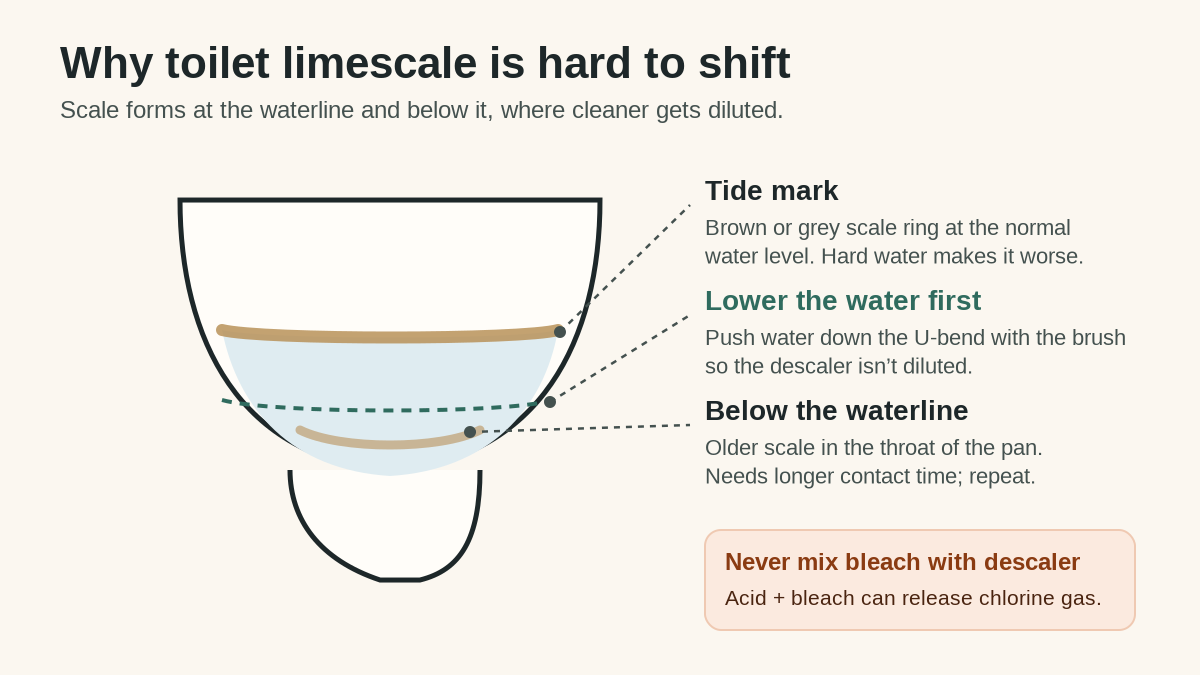
- Think about the rest of the house. If the kettle scales quickly, so will your shower head, taps and washing machine. Mira’s guide to descaling a shower head and our guide to toilet limescale cover the next most common trouble spots.
Signs your kettle needs descaling
You don’t need a calendar to tell you. Look out for:
- a white, grey or brown crust on the base or the element;
- flakes floating in your tea, or a scummy film on the surface;
- the kettle taking noticeably longer to boil, or getting louder as it heats;
- a slow, spitting pour, which usually means the spout filter is clogged;
- the kettle switching off before the water has properly boiled.
Concealed elements and glass kettles
Most modern kettles have a flat, concealed element under a stainless steel plate rather than an exposed coil. They scale up in the same way, but they’re easier to wipe clean. After descaling, a soft sponge removes anything left. Don’t use wire wool or abrasive pads, which scratch the plate and give scale somewhere to grip.
Glass kettles show every speck of scale, which is why they seem to need more attention. The method’s the same. Some people find it easiest to do a quick citric acid descale every couple of weeks, so it never builds up.
Is it time for a new kettle?
If the kettle still spits, leaks, trips the electrics or switches off at random after a thorough descale, stop using it. These can be signs of a fault rather than scale. A kettle that’s badly corroded inside, or has a damaged cable or base, should be replaced. When you buy, a removable, washable limescale filter is worth having in a hard water area.
What about a water softener?
A whole-house water softener stops scale everywhere, but it’s a significant cost to buy and run. The DWI’s guidance on filters and softeners recommends keeping an unsoftened supply for drinking and cooking. Softened water contains more sodium, so it isn’t recommended for making up baby feeds. For most people, a filter jug and regular descaling is a perfectly good answer for the kettle.
Frequently asked questions
Is limescale in my kettle harmful?
No. Limescale is mainly calcium carbonate and isn’t harmful to drink. Which? and the Drinking Water Inspectorate both say hard water is safe. It can make tea taste flat and leave flakes in your cup, and it makes the kettle take longer, using more energy.
Is citric acid or vinegar better for descaling?
Both work. Citric acid is faster when added to hot water, and it doesn’t leave a strong smell. Vinegar is something many people already have, but it smells and needs more rinsing.
Can I descale a kettle with lemon juice?
Yes, it works for light scale. Squeeze a couple of lemons into a half-full kettle, add the squeezed halves, boil, leave for an hour, then rinse. It’s weaker than citric acid powder, so heavy scale may need a second go.
Why does my kettle still have white bits after descaling?
Some loose scale settles in the bottom or gets stuck in the spout filter. Rinse thoroughly, wipe the base with a soft brush, and clean the filter. If the scale is thick, repeat the descale.
Do water filter jugs stop limescale?
Filter jugs reduce the minerals that cause scale, so you’ll descale less often. You need to change the cartridges as the manufacturer says. Expect slower build-up, not none.
This guide is general advice for UK homes. Your appliance manual and product labels come first: if they say something different, follow them. Spotted something wrong or out of date? Tell us and we’ll check and correct it.