That brown or grey ring sitting just at the waterline of the toilet bowl isn’t dirt, and no amount of bleach will shift it. It’s limescale: calcium carbonate left behind by hard water, gradually stained by everything that passes through. Over time it builds up into a hard, rough crust that also traps bacteria and more staining.
The trick to removing it isn’t a stronger product. It’s getting the product onto the scale undiluted, and giving it time.
Why toilets get limescale
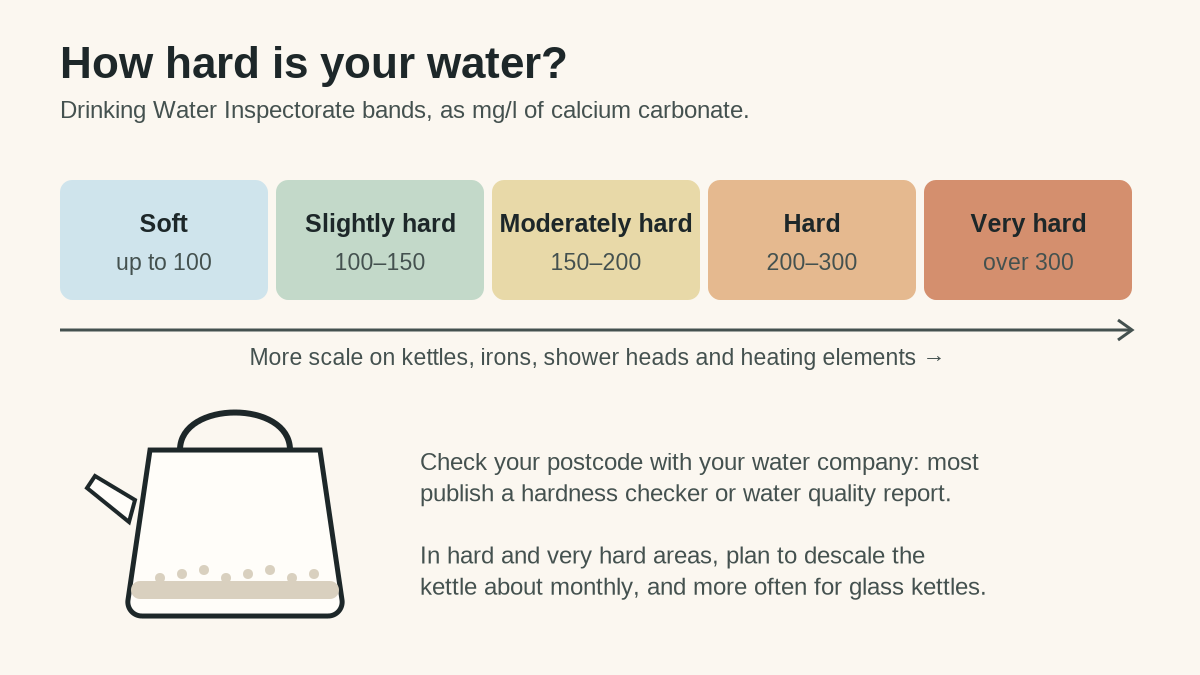
Every flush leaves a thin film of water on the bowl. When that water sits still, minerals settle out. In hard water areas, which cover much of England, especially the South East, East Anglia and the Midlands, there’s a lot of mineral to settle. The Drinking Water Inspectorate classes water as hard above 200 mg/l of calcium carbonate. Your water company can tell you the figure for your postcode. Southern Water, for example, has a postcode checker.
Scale builds up in three places:
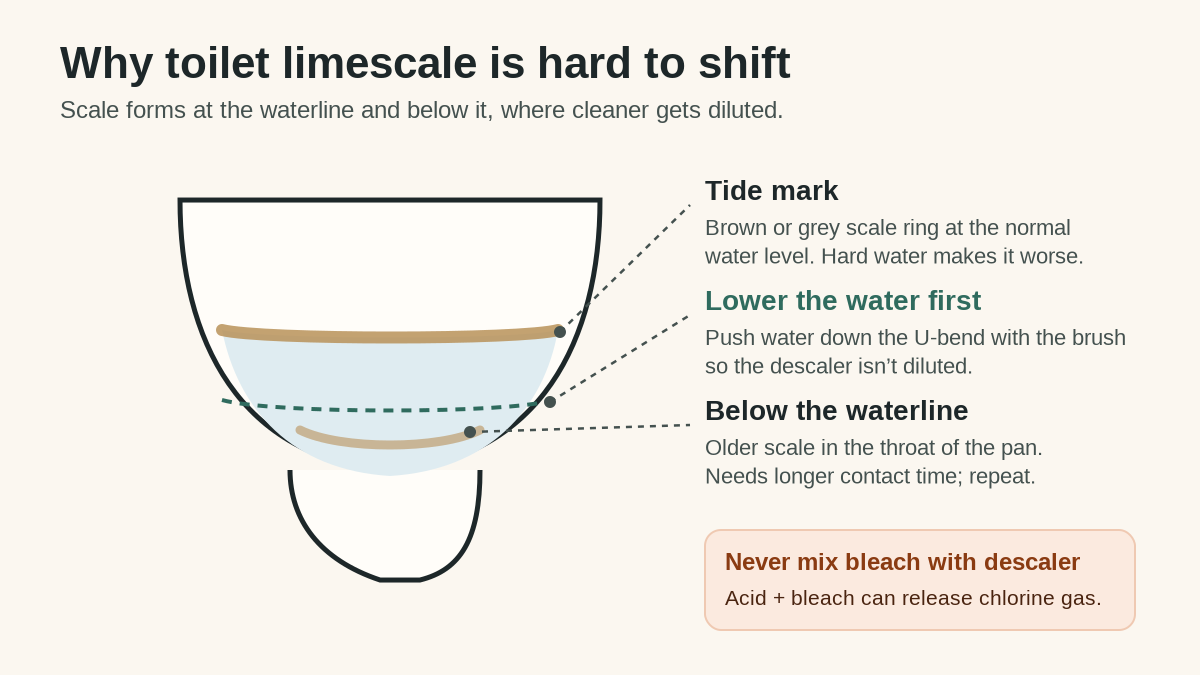
- The tide mark at the normal water level.
- Under the rim, where water flows out during the flush.
- The throat of the bowl, below the waterline. This is where the oldest scale often sits, and where most people never manage to reach.
Bleach vs descaler: what actually works
| Product |
Removes limescale? |
Notes |
| Bleach |
No. It lightens the colour only. |
Disinfects. Never mix with acids. |
| Toilet limescale remover (acid-based) |
Yes |
Strongest home option. Follow the label carefully. |
| Citric acid powder |
Yes, slowly |
Cheap, mild, low odour. Best left overnight. |
| White vinegar |
Weakly |
Very slow on thick scale |
| Pumice stone (wet) |
Yes, mechanically |
White vitreous china only. Gentle pressure. |
Which?, drawing on advice from the British Cleaning Council, makes the key point clearly: bleach won’t tackle limescale, it will only lighten it. You need a descaler.
Never mix bleach and limescale remover. Limescale removers are acids. Bleach (sodium hypochlorite) mixed with an acid can release chlorine gas, which harms the lungs and eyes. The UK Health Security Agency and the London Fire Brigade both warn about this. Watch out for in-cistern blocks and rim blocks, which can contain bleach. Remove them, and flush a few times, before you descale. Wear gloves and keep the window open. If you get descaler on your skin or in your eyes, rinse with plenty of water and see the NHS advice on chemical burns.
How to remove toilet limescale, step by step
1. Clear the decks
Take out any rim blocks or in-cistern tablets, and flush two or three times with the lid down to rinse away any bleach residue. Put on rubber gloves and open the window.
2. Lower the water level
Which? quotes the British Cleaning Council’s “flush, push and brush” method. Flush, then plunge the toilet brush firmly into the bottom of the bowl and push the water down the U-bend. Do it a few times, and the water level will drop, exposing the tide mark and some of the throat.
For heavy scale below the waterline, you can empty the bowl further. Turn off the water to the cistern (there’s usually an isolation valve on the pipe, which you turn with a flat-head screwdriver), flush, then scoop out the remaining water with a disposable cup into a bucket, and soak up the last bit with a disposable cloth. Remember to turn the water back on afterwards.
3. Apply the descaler
Limescale remover: squirt it all round the tide mark, under the rim and down into the throat. Follow the label’s contact time. Some products say not to leave them longer than a set time.
Citric acid: dissolve two or three tablespoons of citric acid powder in a jug of warm (not boiling) water and pour it over the scale. If you’ve emptied the bowl, you can mix a thick paste and press it onto the scale with a cloth.
4. Wait
This is where most attempts fail. Acids dissolve limescale slowly. Give a toilet descaler the full time the label allows. Citric acid works well overnight. Put the lid down and a note on it if others might use the toilet.
5. Scrub
Scrub hard with the toilet brush, especially the tide mark. For stubborn spots on standard white vitreous china, a pumice stone made for toilets, kept wet, can grind away what’s left. Use light pressure, keep it wet, and test a small area first. Don’t use pumice on plastic, enamel, coloured or decorative bowls.
6. Flush and repeat
Flush with the lid down. Thick, years-old scale often needs two or three treatments.
Keeping limescale away
- Clean weekly with a toilet cleaner, and descale every few months. The British Cleaning Council suggests about every three months, more often in hard water areas.
- Brush under the rim each time you clean. Scale under the rim can block the flush holes and weaken the flush.
- Flush regularly in toilets that aren’t used much, like a guest loo. Standing water leaves thicker rings.
- Consider a water softener if you’re fitting one for the whole house anyway. The DWI has guidance on choosing and fitting one, including keeping a hard-water tap for drinking.
What to buy in UK shops
You don’t need anything specialist or expensive.
- Toilet limescale removers are sold in every supermarket, both branded and own-brand, usually in angled-neck bottles that reach under the rim. Look for “limescale remover” rather than just “toilet cleaner”. Many everyday toilet cleaners are bleach-based and won’t touch scale. The label will tell you which it is, and will carry hazard warnings either way.
- Citric acid is sold as a powder in the baking or cleaning aisle of larger supermarkets, in hardware shops, and online. It’s also the active ingredient in many kettle descalers.
- Toilet pumice stones are sold in hardware shops and online, often on a handle so you don’t have to put your hand in the bowl.
Keep all of them in their original containers, out of reach of children, and away from bleach products.
Cleaning the seat and hinges
While you’re there, the seat deserves attention too. Which? passes on the British Cleaning Council’s tip to remove the seat now and again, using a screwdriver on the bolts, so you can clean the brackets, hinges and fixing holes where grime collects. Wash the seat with warm water and a mild detergent or bathroom cleaner. Avoid descaler and pumice on the seat, because plastic and wooden seats can be marked or stripped by acids and abrasives.
When it’s not limescale
A rust-coloured stain running down from under the rim may be iron in the water, or a sign of old metal pipework. A pink or black ring that comes back quickly is usually bacteria or mould, which a normal toilet cleaner removes. A crack in the bowl, or a stain that looks like it’s inside the glaze, can’t be cleaned away.
A quick word on the cistern
Limescale also builds up inside the cistern on the flush valve and fill valve, and can cause a toilet that runs constantly. Some descaler products are designed to be used in the cistern, but check the instructions and the toilet manufacturer’s advice. Never put bleach blocks in the cistern if you also use acid descalers.
Frequently asked questions
What dissolves heavy limescale in a toilet?
Acids dissolve limescale. Dedicated toilet limescale removers are the strongest option you can buy for home use, and citric acid powder is a cheaper, milder alternative. Lowering the water level first and giving the product time to work make the biggest difference.
Does Coca-Cola remove limescale from toilets?
It contains a weak acid and may soften very light scale, but it’s much less effective than a proper descaler or citric acid, and the sugar is sticky. It isn’t worth it.
Can I use bleach to remove limescale?
No. Which? notes that bleach won’t remove limescale, only lighten its colour. Bleach must never be mixed with descalers or vinegar, because the combination can release toxic chlorine gas.
Will a pumice stone scratch my toilet?
Used wet and gently on standard white vitreous china, a pumice stone made for toilets usually removes scale without scratching. Don’t use it on plastic, enamel, coloured or decorative finishes, or on the seat. Test a small area first.
How often should I descale my toilet?
The British Cleaning Council, quoted by Which?, suggests using a descaler periodically, perhaps once every three months, and more often in hard water areas.
This guide is general advice for UK homes. Your appliance manual and product labels come first: if they say something different, follow them. Spotted something wrong or out of date? Tell us and we’ll check and correct it.