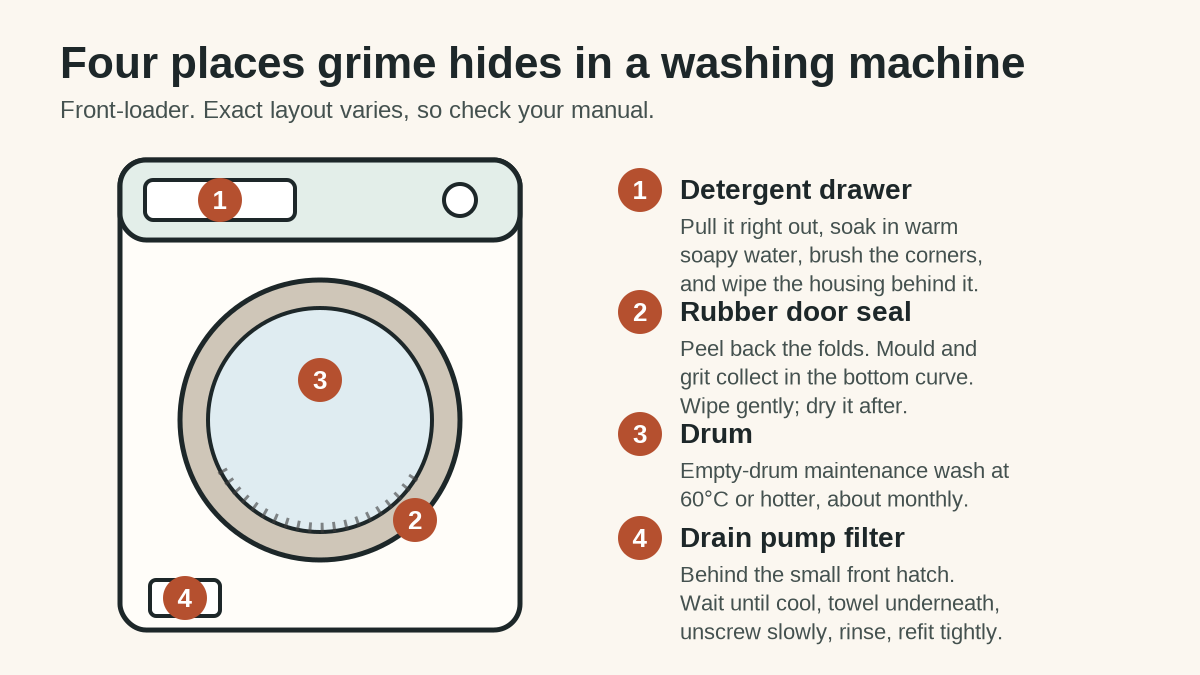
A washing machine that smells of damp or old drains is almost never broken. It’s dirty in four places you rarely see: the detergent drawer, the folds of the rubber door seal, the drum, and the drain pump filter tucked behind a hatch at the bottom. Clean those four and the smell usually goes with them.
This guide is for front-loading machines, which is what most UK homes have. Top-loaders and washer-dryers work on the same principles, but check your manual for the details, especially for the filter.
Why washing machines start to smell
Modern washing is gentle on the planet and kind to clothes, but it’s not kind to the machine. Short eco cycles at 30°C or 40°C don’t get hot enough to break down the film of detergent, fabric softener, body oils and lint that builds up out of sight. Add a door that’s shut straight after the wash, and you have a warm, damp, dark space where bacteria and mould are very happy.
Which? points to the same culprits: too many low-temperature washes, too much detergent or softener, and not letting the machine dry out. Liquid detergents and softeners are the worst for leaving residue. Powders usually contain a bleaching agent that helps keep the inside cleaner.
Safety first. Unplug the machine before you take anything apart, and wait until it’s cool before you open the filter, because the water behind it can be hot after a wash. Never mix bleach with limescale remover, vinegar or other cleaners. Bleach and acids can release chlorine gas (UK Health Security Agency). Use one product at a time and rinse in between.
Step 1: Clean the detergent drawer
The drawer collects slimy, half-dissolved detergent and softener, and black mould often grows in the corners and in the channel it slides into.
- Pull the drawer out as far as it goes, then press the release tab (usually marked “push” in the softener compartment) and lift it out.
- Take out the siphon cap (the small plastic cover in the softener section) if it comes off. Most do.
- Soak everything in a washing-up bowl of hot water with a squirt of washing-up liquid for 10 to 15 minutes.
- Scrub the corners and the underside with an old toothbrush, then rinse.
- While it soaks, look into the empty housing with a torch. Scrub the roof of the cavity, where water jets come in, and wipe out the gunk.
- Dry the drawer and slide it back in.
Some drawers are dishwasher-safe, but many aren’t, so check the manual before you try.
Step 2: Clean the rubber door seal
The door seal (gasket) is the usual source of a musty smell. Water, hair, fluff, coins and the odd sock sit in its folds, especially the bottom curve.
- Peel back the folds all the way round. Wear gloves: it can be grim.
- Pick out anything solid, then wipe the folds with a cloth dipped in warm water and washing-up liquid.
- Use a toothbrush gently on black marks. Don’t use anything abrasive or sharp, which could split the rubber and cause a leak.
- Wipe with clean water, then dry the folds with a towel.
Black spots that won’t shift are mould that has stained the rubber. Electrolux’s care guide recommends regular maintenance washes and leaving the door open to stop it coming back. A stained seal doesn’t always mean a dirty seal. If the staining is deep and the smell stays, a replacement seal is a common repair.
Step 3: Empty the drain pump filter
This is the job most people skip, and the one that often fixes both smells and drainage problems. The filter catches hair, lint, hair grips, buttons and coins before they reach the pump.
You’ll find it behind a small hatch on the bottom front corner of the machine. Some machines have a thin emergency drain hose beside it.
- Make sure the machine is off, unplugged and cool.
- Lay old towels on the floor and put a baking dish or shallow tray underneath. There will be more water than you expect, often more than a litre.
- If there’s an emergency hose, pull it out, remove its cap and let the water drain into the tray. Stop and empty the tray as often as you need to.
- Unscrew the filter slowly, anticlockwise, and let the last of the water out.
- Pull out the filter, rinse it under the tap and clear out anything stuck to it.
- Look into the opening with a torch and remove anything caught inside, without poking at the pump impeller.
- Screw the filter back in firmly. If it’s not tight, the machine will leak on the next wash.
Check the filter every few months, or straight away if the machine drains slowly or stops with a drain error.
Step 4: Run a hot maintenance wash
Once the parts you can reach are clean, it’s time to clean the parts you can’t, such as the outer drum, hoses and sump.
- Make sure the drum is empty.
- Add a washing machine cleaner following the pack instructions, or a normal dose of powder detergent in the main wash compartment.
- Run a cotton cycle at 60°C or 90°C. Many machines have a dedicated “drum clean” or “tub clean” programme. Use it if you have one.
Which? compared washing machine cleaners and found you don’t need to pay a lot. A hot wash with an ordinary detergent does much of the work, and budget cleaners can perform well.
| Option |
Typical cost |
Good for |
Watch out for |
| Dedicated washing machine cleaner |
About £2–£5 per treatment |
A monthly deep clean, smells |
Follow the dose on the pack. Don’t combine with other products. |
| Powder detergent on a hot wash |
Pennies |
Routine maintenance |
Use powder rather than liquid for the bleaching action |
| Machine’s “drum clean” programme |
Free |
Regular upkeep |
Usually needs a cleaner or detergent added |
| Vinegar |
Cheap |
Not recommended |
Can damage seals and hoses with regular use |
Step 5: Finish off and let it dry
Wipe the door glass inside and out, and the outside of the machine, with a damp cloth. Then leave the door and the drawer slightly open. This is the single best habit for stopping smells coming back.
Hard water and limescale
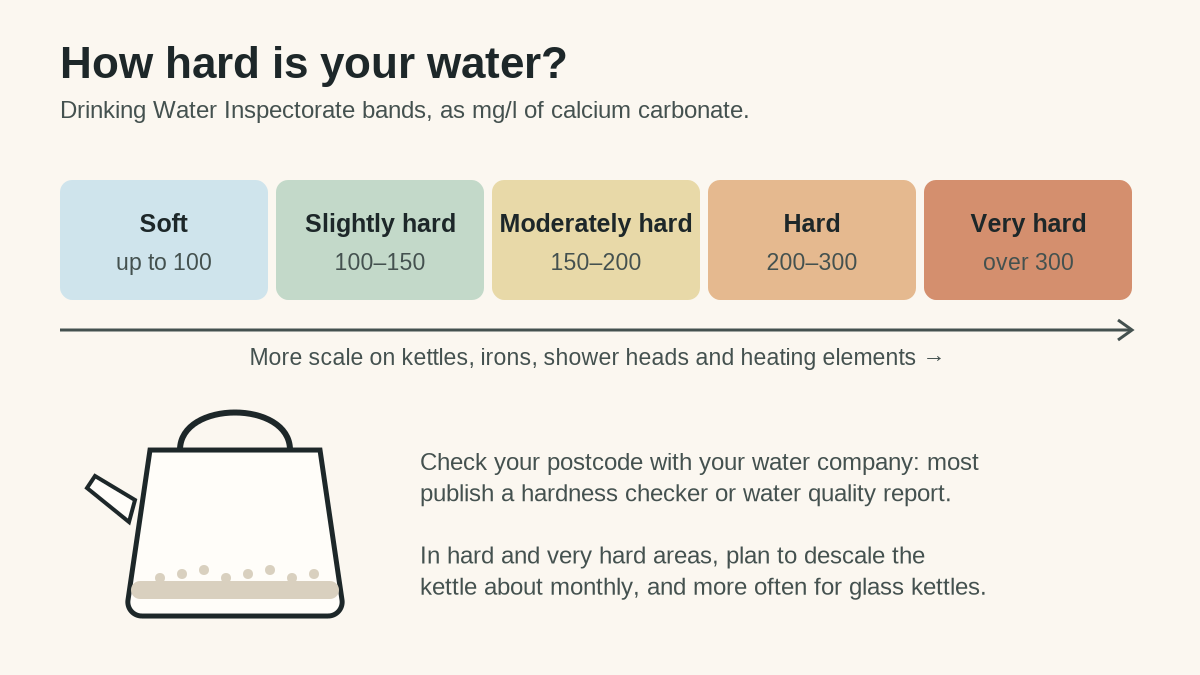
UK note. Much of England, particularly the South East, East Anglia and the Midlands, has hard water. The Drinking Water Inspectorate classes water above 200 mg/l of calcium carbonate as hard. Your water company’s website will tell you the hardness for your postcode.
In practice, limescale is less of a worry for washing machines than for kettles and showers. Most detergents contain softening agents, and the right dose for your water hardness, shown on the pack, takes care of most of it. If you’re in a very hard water area and see chalky white deposits on the drum or seal, use a descaling product made specifically for washing machines. Don’t use it at the same time as any bleach-based cleaner.
How to stop the smell coming back
- Run a hot wash regularly. A 60°C wash for towels and bedding once a week or so helps keep the inside clean.
- Use less product. Overdosing liquid detergent and softener leaves residue. Follow the pack for your water hardness and load size.
- Use powder sometimes. Its bleaching agents help keep the drum and pipes cleaner.
- Leave the door and drawer ajar after every wash.
- Take washing out promptly. Damp clothes left in the drum smell, and so does the machine.
- Check the filter every few months.
When it’s not a cleaning problem
If the machine still smells after a full clean, the problem may be the drain rather than the machine. A standpipe or sink trap without a proper water seal can let drain smells back up the hose. Water pooling under the machine, a burning smell, error codes that don’t clear, or a door that won’t open after a cycle all mean it’s time to stop, unplug it and call the manufacturer or a qualified repairer.
Frequently asked questions
How often should I clean my washing machine?
A hot maintenance wash about once a month, and cleaning the drawer and seal at the same time, is a sensible routine for most homes. Check the drain pump filter every few months, or straight away if the machine is slow to drain.
Can I use bleach to clean a washing machine?
Some manufacturers allow a small amount of diluted bleach on the door seal, but check your manual first. Never use bleach at the same time as a limescale remover, vinegar or any other cleaner, because bleach and acids can release toxic chlorine gas.
Should I use vinegar in my washing machine?
It is best avoided. Some manufacturers warn that regular use of vinegar can damage rubber seals and hoses. A proper washing machine cleaner or a hot wash with powder detergent does the job without that risk.
Why does my washing machine smell even though I clean it?
The usual causes are frequent low-temperature washes, using too much liquid detergent or fabric softener, leaving the door shut after washing, and a dirty drain pump filter. Run hot washes more often and let the drum dry out between loads.
Do I need to descale a washing machine in a hard water area?
Most modern detergents contain water softening agents, so a separate descaler is not usually needed. If you are in a very hard water area and see white scale on the drum or seal, use a product made for washing machines and follow the label.
This guide is general advice for UK homes. Your appliance manual and product labels come first: if they say something different, follow them. Spotted something wrong or out of date? Tell us and we’ll check and correct it.