Soft furnishings
How to clean a sofa: fabric, leather and velvet
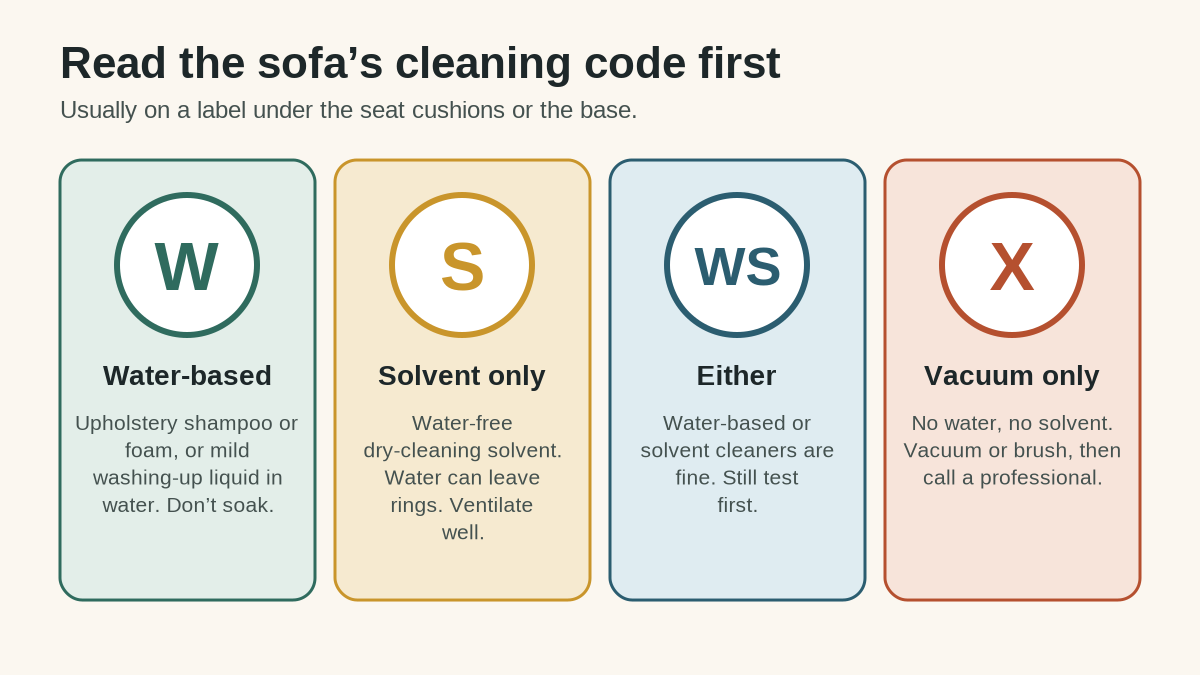
How to clean a fabric, leather or velvet sofa safely: reading the W, S, WS and X cleaning codes, lifting common stains, washing removable covers and freshening without soaking.
Soft furnishings
How to clean a mattress without soaking it: a simple six-monthly routine, how to lift blood, urine, sweat and tea stains, freshening with bicarbonate of soda, and memory foam dos and don’ts.
You change your sheets every week or two, but the mattress underneath goes years without a clean. Which?, citing The Sleep Council, notes that an adult loses around 285ml of fluid a night, and we shed hundreds of grams of skin a year, much of it into the bed. That’s food for dust mites and a source of stains and smells.
The good news is that cleaning a mattress is mostly dry work: vacuuming, a bit of careful spot-cleaning, and fresh air. The one rule that matters more than anything else is don’t soak it. Mattresses aren’t waterproof, and water that gets deep into the filling or foam is slow to dry and can lead to mould.
Look for the care label, usually sewn into a side seam. It may tell you:
This matters most for memory foam and hybrid mattresses. Some covers are machine washable. Others shouldn’t be removed at all, because the cover is part of the mattress’s structure. Getting it wrong can shrink the cover or affect your warranty.
Take off everything, including the protector, and put it all in the wash. Bedding is best washed at 60°C if the label allows. Check the mattress for stains while it’s bare.
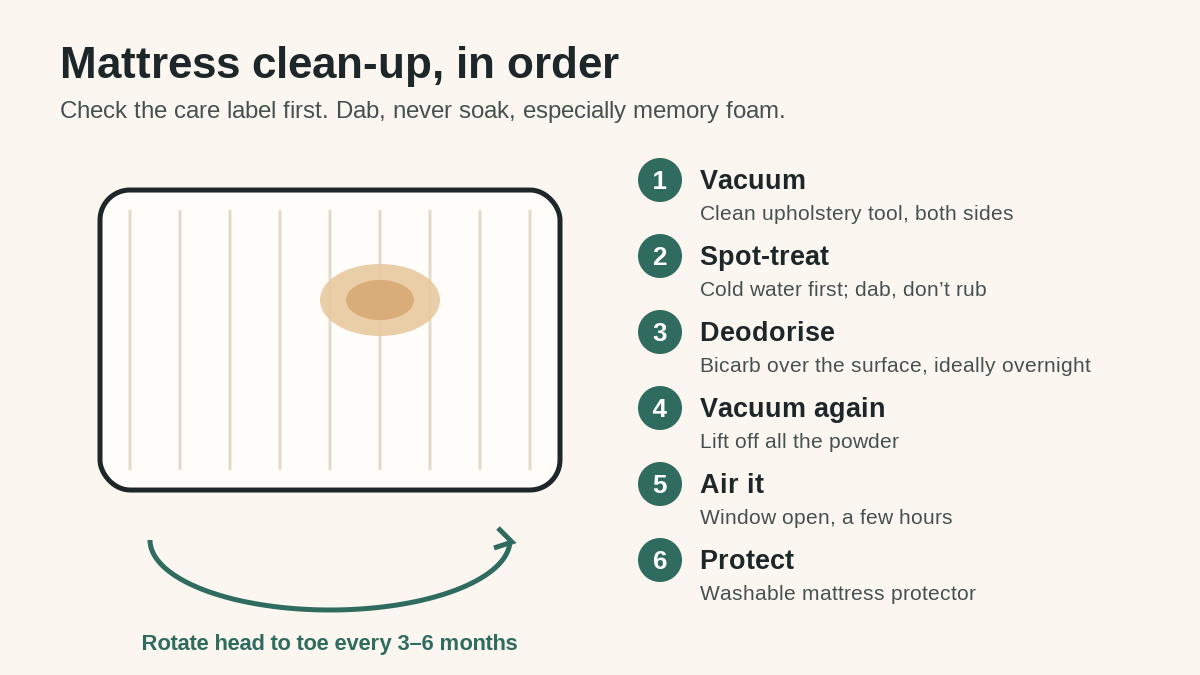
Vacuum the whole top surface slowly with the upholstery tool. Then go back over the seams, edges, buttons and any quilting, where dust and skin collect. Do the sides, and the underside if it’s two-sided. Vacuum under the bed while you’re there, which really helps if anyone in the house has allergies.
See the stain guide below. Treat stains before you add bicarb, and let them dry first.
Sieve a thin, even layer of bicarbonate of soda over the top. Leave it for at least a few hours, ideally overnight with the window open. Bicarb absorbs moisture and neutralises some smells. Then vacuum it all off slowly, using the upholstery tool. Leftover powder is gritty and attracts moisture.
Open the windows and leave the mattress uncovered for a few hours. Air moving through the fabric helps it dry and freshen. A sunny, dry day is ideal.
Turn the mattress head to toe, or flip it too if it’s two-sided. Which? recommends rotating every three to six months. Put on a clean protector, then your bedding.
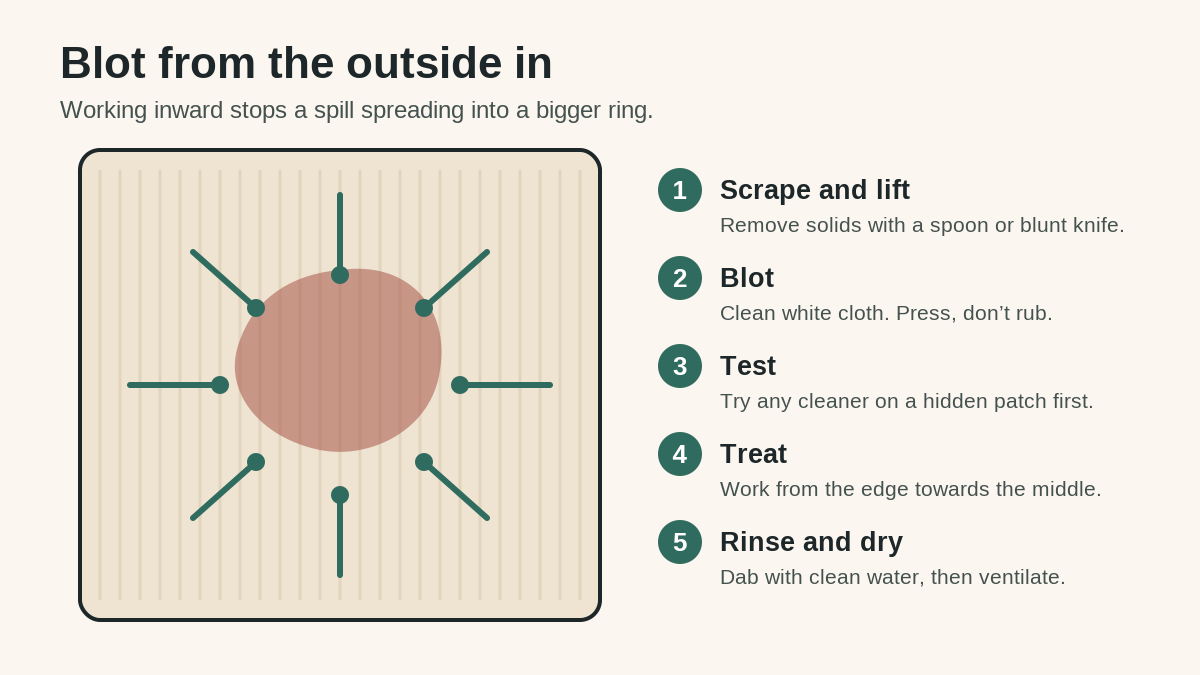
Three golden rules for every stain: act quickly, check the label, and test on a small area first. Dab with a barely damp cloth from the outside of the stain towards the middle, so it doesn’t spread. Never rub hard, and never pour liquid on.
| Stain | What to use | How |
|---|---|---|
| Blood | Cold water only to start | Dab with cold water. Warm water sets blood. If it persists, add a little bicarb to the water, leave 30 minutes, dab off. |
| Urine | Washing-up liquid in water | Blot up as much as you can, dab with diluted washing-up liquid, then clean water. Bicarb overnight once dry. |
| Sweat (yellow patches) | Washing-up liquid in water | Dab gently, rinse with a clean damp cloth, dry thoroughly |
| Tea, coffee, juice | Bicarb and cold water | Make a thin mixture, dab on, leave 30 minutes, dab off with clean water |
| Vomit | Remove solids, then washing-up liquid | Scrape off, blot, dab with diluted washing-up liquid, then clean water. Air well. |
These methods follow Which?’s mattress stain advice. If a stain doesn’t shift and the label allows it, a diluted upholstery cleaner applied to a cloth, not sprayed straight onto the mattress, is the next step.
Go gently with products. Don’t use bleach on a mattress. Never mix cleaning products, and never use bleach alongside other cleaners, because some combinations release toxic gases. Keep the room ventilated, and let the mattress dry completely before anyone sleeps on it. A damp mattress under a sheet is how mould starts.
If an accident has made part of the mattress wet:
If anyone in the house has asthma or allergies, regular vacuuming, a protector and washing bedding hot all help reduce dust mites. Allergy-proof covers, sometimes called barrier covers, enclose the whole mattress. The NHS asthma pages list dust mites as a common trigger. If symptoms are bad, speak to a GP or pharmacist.
| How often | Job |
|---|---|
| Every 1–2 weeks | Wash sheets and pillowcases |
| Every 1–2 months | Wash the mattress protector |
| Every 3–6 months | Rotate (and flip, if two-sided) |
| About every 6 months | Vacuum, freshen with bicarb, air |
| Straight away | Deal with spills and accidents |
If a mattress is heavily stained but otherwise in good condition, a professional upholstery cleaner is an option. Ask what method they use and how wet the mattress will get. Low-moisture methods are better for mattresses. Ask them to confirm it’ll be dry before night-time, and check your mattress manufacturer’s advice first, since some warranties exclude damage from cleaning.
Carpet cleaning machines from the supermarket or DIY shop are designed for carpets that can take a soaking. Which? recommends caution with them on mattresses. If you do use one, use the upholstery tool, put down as little water as possible, extract as much as you can, and allow a long drying time with the windows open.
A smell that returns after cleaning usually means moisture is getting deep into the mattress, from sweat, spills or a damp room. Look at the room as well as the bed. Is there condensation on the windows in the morning, or mould in the corners? A mattress on the floor or on a solid base can’t breathe underneath and is more likely to get damp. A slatted base, and lifting the duvet back each morning to let the bed air, both help. If the room itself has a damp problem, see our guide to dealing with mould on walls.
Cleaning can’t fix a mattress that sags, has lumps or springs you can feel, or leaves you waking up stiff. If cleaning doesn’t remove a persistent smell, or there’s mould inside, it’s time for a new one. Most councils offer a bulky waste collection for the old one, usually for a fee, and some retailers will take your old mattress away when they deliver a new one.
Which? suggests every six months is advisable, ideally when you rotate or flip it. Clean it more often if you have allergies, and deal with spills and accidents straight away.
It’s risky. Carpet cleaning machines put a lot of water into the fabric, and mattresses are not designed to get wet. That can lead to mould and damage foam. Only use one if the mattress manufacturer allows it, with an upholstery tool and as little water as possible.
Blot up as much as you can straight away, dab with diluted washing-up liquid, then dab with clean water. Once it’s dry, sprinkle bicarbonate of soda and leave it overnight before vacuuming. Enzyme-based cleaners for pet stains can help with lingering smells. Test them on a hidden area first.
Sometimes. Some covers are machine washable and some manufacturers say not to remove them at all. Follow the label exactly, because the wrong wash can shrink the cover or affect your warranty.
New mattresses, especially roll-up foam ones, often have a smell for a day or two. Unwrap it in a well-ventilated room, open the windows and give it time before putting bedding on.
This guide is general advice for UK homes. Your appliance manual and product labels come first: if they say something different, follow them. Spotted something wrong or out of date? Tell us and we’ll check and correct it.
How to clean a fabric, leather or velvet sofa safely: reading the W, S, WS and X cleaning codes, lifting common stains, washing removable covers and freshening without soaking.
How to deep clean a carpet by hand or with a hired machine, how to remove common stains like red wine, tea, mud and pet accidents, and how to get rid of smells, with UK products and costs.

How to remove small patches of black mould from walls, ceilings and window reveals safely, what causes it in British homes, and when to stop and report it to your landlord instead.